Five-year OPTIC follow-up confirms benefit of response-based ponatinib dosing in chronic-phase CML
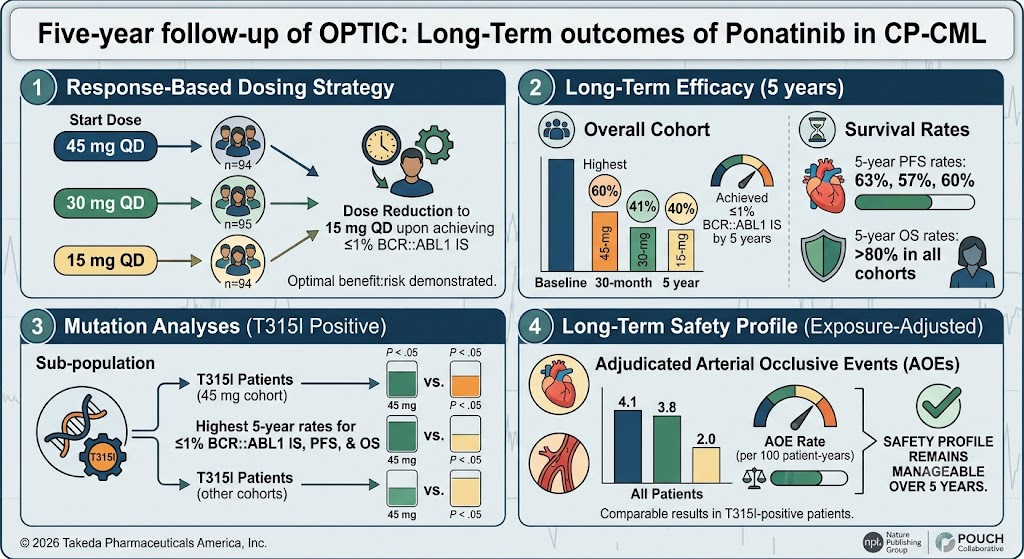
In the OPTIC trial, patients with chronic-phase CML resistant to ≥2 prior TKIs or with T315I mutation were randomized to starting doses of ponatinib 45 mg, 30 mg, or 15 mg once daily; those in the 45 mg and 30 mg cohorts reduced to 15 mg upon achieving ≤1% BCR::ABL1IS.
At 5 years, the 45 mg starting dose cohort achieved the highest rates of molecular response (60% ≤1% BCR::ABL1IS), progression-free survival (63%), and overall survival (>80%).
Exposure-adjusted rates of adjudicated arterial occlusive events were 4.1, 3.8, and 2.0 per 100 patient-years in the 45 mg, 30 mg, and 15 mg cohorts, respectively.
In patients with T315I mutation, the 45 mg starting dose consistently produced the best 5-year outcomes across efficacy endpoints.
These data support a response-based dosing strategy for ponatinib in third-line or T315I-positive CP-CML, balancing durable efficacy with reduced long-term toxicity.
Clinical Context: Optimizing Ponatinib Dosing in Resistant CML
Ponatinib is a potent BCR-ABL1 tyrosine kinase inhibitor (TKI) that retains activity against most resistance mutations, including T315I. Earlier experience from the PACE trial confirmed deep and durable responses in heavily pretreated chronic-phase CML (CP-CML), but also revealed a dose-dependent risk of arterial occlusive events (AOEs). The OPTIC trial (NCT02467270) was designed prospectively to test whether a response-based dose-reduction strategy could preserve efficacy while reducing long-term vascular toxicity. The primary analysis, reported in 2021, demonstrated that a 45 mg starting dose with reduction to 15 mg upon achieving ≤1% BCR::ABL1IS produced the best balance of efficacy and safety. Now, with a median follow-up of 75–78 months, the investigators have published the 5‑year outcomes, affirming the durability of responses and the sustained benefit of this approach.
Study Design: Response-Based Dose Reduction in the OPTIC Trial
OPTIC was a phase 2, open-label, randomized trial conducted across multiple centers worldwide. Eligible adults had CP-CML resistant to or intolerant of at least two prior BCR-ABL1 TKIs, or carried a BCR-ABL1 T315I mutation. Patients were randomly assigned 1:1:1 to one of three starting doses of ponatinib: 45 mg, 30 mg, or 15 mg once daily. In the 45 mg and 30 mg cohorts, the dose was reduced to 15 mg once the patient achieved BCR::ABL1IS transcript levels ≤1% (the primary endpoint threshold). The primary endpoint was the proportion of patients achieving ≤1% BCR::ABL1IS at 12 months. Key secondary endpoints included progression-free survival (PFS), overall survival (OS), and safety, particularly arterial occlusive events. A prespecified subgroup analysis examined outcomes in patients with a T315I mutation. From August 2015 through May 2019, 283 patients were enrolled (94, 95, and 94 in the 45 mg, 30 mg, and 15 mg arms, respectively). At the 5‑year data cutoff, 61 patients remained on trial.
Primary Endpoint: Higher Starting Dose Yielded Higher Response Rates
At the primary analysis (12 months), the response rates (≤1% BCR::ABL1IS) were 44.1% (98.3% CI 31.7–57.0) in the 45 mg cohort, 29.0% (18.4–41.6) in the 30 mg cohort, and 23.1% (13.4–35.3) in the 15 mg cohort. These differences indicated a dose-response relationship, with the 45 mg starting dose providing significantly higher early molecular responses. The response-based dose reduction did not compromise this early advantage.
Long-Term Efficacy: Sustained Responses and Survival Beyond 5 Years
By 5 years, the cumulative rates of ≤1% BCR::ABL1IS were 60%, 41%, and 40% for the 45 mg, 30 mg, and 15 mg cohorts, respectively. Five‑year PFS rates were 63%, 57%, and 60%, while OS rates exceeded 80% in all three arms. These data show that the initial benefit of the 45 mg starting dose is maintained over the long term, with conversion to response continuing after the first year. The absolute differences among arms for PFS and OS were modest, likely because all patients eventually received ponatinib at some dose and because effective rescue therapies were available. The median follow-up of 75–78 months provides robust evidence of durability.
Safety Profile: Arterial Occlusive Events Dose-Dependent
Arterial occlusive events remain the most clinically significant toxicity associated with ponatinib. In the OPTIC trial, AOEs were adjudicated by an independent committee. Over the full 5‑year follow-up, the exposure-adjusted rate of adjudicated AOEs was 4.1 patients per 100 patient-years in the 45 mg cohort, 3.8 per 100 patient-years in the 30 mg cohort, and 2.0 per 100 patient-years in the 15 mg cohort. These rates are lower than those reported in the earlier PACE trial, supporting the hypothesis that response-based dose reduction reduces cumulative AOE risk. Grade 3 or higher treatment-emergent AOEs (independently confirmed in the primary analysis) occurred in 5, 5, and 3 patients of each cohort, respectively. The safety profile was generally manageable, and discontinuations due to adverse events were within expected ranges for this heavily pretreated population.
T315I Mutation Subgroup: Clear Benefit with 45 mg Starting Dose
Patients with the T315I mutation are a particularly challenging subgroup, as they are resistant to most TKIs except ponatinib and possibly asciminib. In the OPTIC trial, 5‑year rates of ≤1% BCR::ABL1IS, PFS, and OS were consistently highest in the 45 mg cohort. The pattern of exposure-adjusted AOE rates in T315I-positive patients was similar to that in the overall population, suggesting that the 45 mg starting dose offers the best therapeutic index in this subgroup. These findings support the use of the 45 mg starting dose as a standard when a T315I mutation is present.
Interpretation and Clinical Implications
The 5‑year OPTIC results confirm that a response-based dosing strategy for ponatinib—initiating at 45 mg and reducing to 15 mg once ≤1% BCR::ABL1IS is achieved—provides durable efficacy and a tolerable long-term safety profile in patients with resistant CP-CML or T315I mutation. The 45 mg starting dose yields higher molecular response rates and better PFS and OS in the T315I subgroup, while the dose-reduction step appears to mitigate the cumulative risk of arterial occlusive events. These data reinforce current guideline recommendations that ponatinib should be started at 45 mg in appropriate patients, with dose reduction upon response. The modest differences in survival among arms (all >80% at 5 years) may reflect effective sequential therapy, but the 45 mg cohort still achieved the best molecular control, which is associated with longer-term outcomes. Clinicians should weigh the higher initial response rate against the moderate increase in AOE risk when choosing a starting dose, and ensure appropriate monitoring for vascular events.
Limitations
The open-label design and relatively small sample size (94–95 per arm) limit definitive comparisons between dose groups. Subgroup analyses, including those for T315I, were not powered for statistical inference. The trial enrolled only CP-CML patients, so results do not apply to advanced-phase disease. Attrition over 5 years was substantial (61 of 283 remained on trial), although survival data were collected for all randomized patients. The exposure-adjusted AOE rates should be interpreted with caution, as they may be affected by differential durations of exposure and competing risks.
Funding, Registration, and Disclosures
The OPTIC trial was sponsored by Takeda Pharmaceutical Company. The long-term follow-up analysis was supported by the same sponsor. The trial is registered at ClinicalTrials.gov (NCT02467270). Disclosures of the authors are listed in the original publications.
References
Kantarjian H, Deininger M, Apperley JF, et al. Five-year follow-up of OPTIC: long-term efficacy, safety, and mutation analyses of ponatinib in chronic-phase chronic myeloid leukemia from a randomized phase 2 trial. Leukemia. 2026; PMID: 42498834.
Cortes J, Apperley J, Lomaia E, et al. Ponatinib dose-ranging study in chronic-phase chronic myeloid leukemia: a randomized, open-label phase 2 clinical trial. Blood. 2021;138(21):2042–2050. doi:10.1182/blood.2021012082. PMID: 34407543.
This article was created using several editorial tools, including AI, as part of the process. Human editors reviewed this content before publication.