We use cookies

Our website uses essential cookies and, with your consent, additional cookies to measure performance and improve our services. Cookie Policy.

You can change your choice at any time.

MMedXYNews
HomeVideos
MedXY AI/MedXY News/Section: General Surgery

Navigating Surgical Decisions in Patients with Dementia: Clinician Challenges and Insights
MedXY Editorial Team•Aug 22, 2026•General Surgery
cognitive impairmentcaregiver involvementsurgical decision-makingElectronic Health RecordsDementia

Highlight

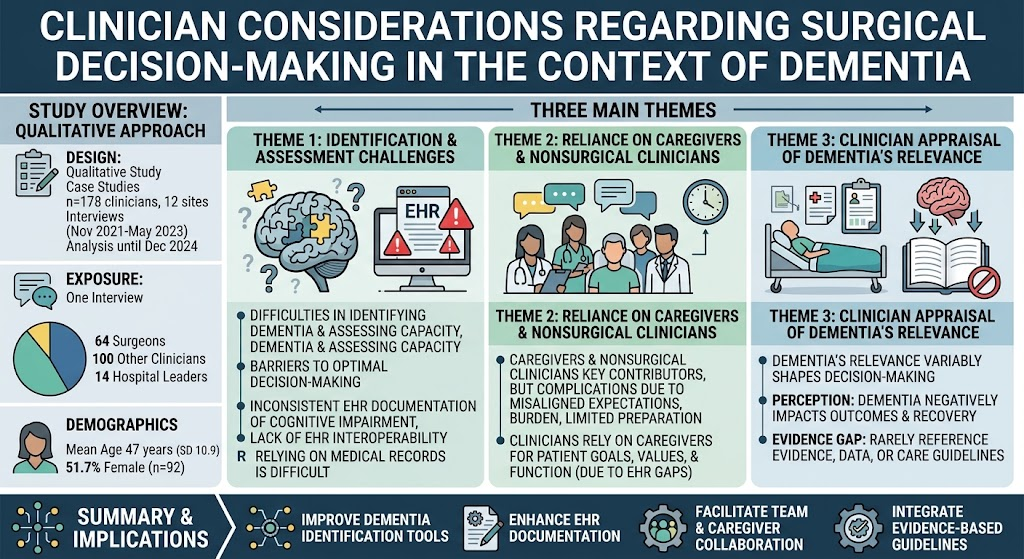
  • Clinicians encounter significant difficulty identifying dementia and assessing decision-making capacity in surgical patients due to inconsistent documentation and limited resources.
  • Caregivers and nonsurgical clinicians play a crucial role in surgical decision-making, though mismatched expectations and caregiver burden complicate communication and planning.
  • Clinician perceptions that dementia adversely affects surgical outcomes are widespread but seldom grounded in explicit evidence or guidelines.
  • Improved EHR interoperability, routine caregiver inclusion, and integration of dementia specialists can enhance surgical decision-making for patients living with dementia (PLWD).

Study Background

MedXY registered readers

Sign in free to continue reading

Create or use your MedXY account to unlock the complete article.

This article was created using several editorial tools, including AI, as part of the process. Human editors reviewed this content before publication.

Related articles

Open language-specific specialty feeds and department pages.

Enabling Technologies in Community Health Centers: Overcoming Barriers to Address Social Determinants of Health in Care-Managed PatientsThis article examines how community health centers use electronic health record tools to address patients’ social needs through care management programs, identifying barriers and proposing targeted implementation strategies to enhanceSep 17, 2026Integrating Plasma p-tau217 and APOE Genotype to Predict Cognitive Decline Across Diverse PopulationsThis pooled analysis of seven multi-ethnic cohorts demonstrates the combined prognostic value of plasma phosphorylated tau 217 concentrations and APOE-ε4 genotype for predicting risk and timing of cognitive impairment, emphasizing biomarkerSep 13, 2026Navigating Surgical Decisions in Dementia: Challenges and Clinical InsightsClinicians face multifaceted challenges during surgical decision-making for patients with dementia, including difficulties in dementia recognition, reliance on caregivers, and lack of evidence-based guidelines, underscoring the need for impAug 23, 2026
Loading comments...
MedXY briefing

Get the free newsletter

Evidence-led clinical news, trends, and analysis—delivered to your inbox.

Ask MedXY AI

Most popular

Intimate Health
Five Benefits for Women Continuing Sexual Activity After Menopause
Intimate Health
Why Some Women Have a Strong Sex Drive—And Why Men Shouldn't Worry About It
Nursing & care
How often should a couple have sex?
Intimate Health
Classic Intimacy Recommendations: How to Help Women Reach Orgasm and Enjoy Mutual Pleasure
Intimate Health
What Makes a Woman "Physiologically Addicted" Is Never Money, But These Two Relationship Qualities
© 2026 MedXY
Contact usAbout usPrivacy PolicyMedXY story
The Promises and Pitfalls of Real-time Benefit Tools in Primary Care: Insights from Clinician Experiences
This article explores primary care providers’ perspectives on real-time benefit tools (RTBTs) embedded in electronic health records, highlighting their potential for cost-conscious prescribing amidst challenges like incomplete data an
Aug 17, 2026
Characterization of Patient-Reported Sleep and Mood Symptoms in Chronic Mild Traumatic Brain Injury: A Comprehensive ReviewThis review synthesizes evidence highlighting the high prevalence and interrelation of sleep disturbances, mood symptoms, and cognitive impairments in chronic mild traumatic brain injury (mTBI), emphasizing the need for integrated assessmenAug 17, 2026
Brain-Predicted Age Difference Enhances Dementia Risk Stratification in Subjective Cognitive Decline Beyond Standard MRI AssessmentBrain-predicted age difference (brain-PAD) from MRI improves early dementia risk prediction in patients with subjective cognitive decline, outperforming traditional visual MRI ratings and offering prognostic value beyond amyloid biomarkers,Aug 11, 2026