Navigating Intraoperative Challenges in Robot-assisted Minimally Invasive Esophagectomy: Incidence, Management, and Surgical Outcomes
Highlight
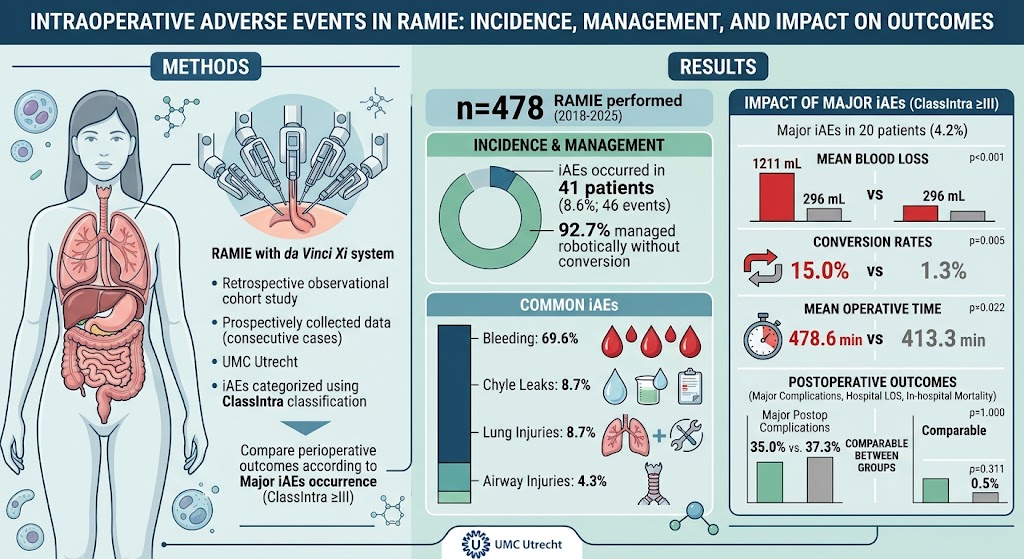
- Intraoperative adverse events (IAEs) occurred in 8.6% of 478 robot-assisted minimally invasive esophagectomies (RAMIE).
- Over 90% of IAEs were managed robotically without converting to open surgery.
- Major IAEs were linked to increased blood loss, longer operative times, and higher conversion rates but did not significantly affect major postoperative complications, mortality, or hospital stay.
- The study underscores feasibility and safety of robotic management of IAEs in an expert high-volume center.
Study Background
Esophagectomy, the surgical removal of the esophagus, remains a complex and high-risk procedure often required for esophageal cancer treatment. Minimally invasive approaches, particularly robot-assisted minimally invasive esophagectomy (RAMIE), have been developed to reduce surgical trauma and improve postoperative recovery. Despite technological advances, intraoperative adverse events (IAEs) remain an intrinsic challenge, potentially affecting both immediate surgical success and long-term patient outcomes. However, data regarding the incidence, management strategies, and consequences of IAEs during RAMIE are limited. Understanding these factors is critical for optimizing patient safety, surgical protocols, and training in robotic esophageal surgery.
Study Design
This retrospective observational cohort study analyzed prospectively collected data on consecutive RAMIE procedures performed between 2018 and 2025 at the University Medical Center Utrecht (UMC Utrecht) using the da Vinci Xi surgical system. IAEs were classified using the standardized ClassIntra system, which grades events by severity, with Grade III or higher indicating major adverse events.
The study compared perioperative outcomes between patients experiencing major IAEs (ClassIntra ≥III) and those without or with minor IAEs. Key outcomes assessed included intraoperative blood loss, conversion rate to open surgery, operative duration, postoperative complications, hospital length of stay, and in-hospital mortality.
Key Findings
A total of 478 RAMIE procedures were reviewed. IAEs occurred in 41 patients (8.6%), with 46 total events reported. The most frequent adverse event was intraoperative bleeding (69.6%), followed by chyle leaks (8.7%), lung injuries (8.7%), and airway injuries (4.3%).
Remarkably, 92.7% of IAEs were successfully managed robotically without conversion to open surgery, demonstrating the potential of robotic platforms for intraoperative troubleshooting. Major IAEs (ClassIntra ≥III) were noted in 20 patients (4.2%). Compared to patients without major IAEs, these cases had significantly increased mean blood loss (1211 mL vs 296 mL, P<0.001), increased operative time (478.6 minutes vs 413.3 minutes, P=0.022), and a higher rate of conversion to open surgery (15.0% vs 1.3%, P=0.005).
Despite procedural challenges, rates of major postoperative complications (35.0% vs 37.3%, P=1.000), median hospital length of stay (11 vs 11 days, P=0.311), and in-hospital mortality (5.0% vs 2.7%, P=0.446) were comparable between patients with and without major IAEs.
These results suggest that although major intraoperative events increase surgical complexity and conversion risk, with expert robotic management, they do not translate into worse short-term clinical outcomes.
Expert Commentary
The findings from this expert high-volume center provide valuable insights into the feasibility and safety of managing IAEs robotically during complex esophageal surgery. The use of the ClassIntra classification ensures robust and standardized adverse event reporting, facilitating comparability across centers.
The preponderance of bleeding events aligns with literature indicating hemorrhage as a common intraoperative complication during esophagectomy, attributable to the rich vasculature of the mediastinum and operative field complexity. The success in robotic management without conversion in the majority of cases underscores the dexterity and enhanced visualization conferred by robotic systems, allowing precise control even in difficult situations.
Limitations include the retrospective design and the single-center setting, which may limit generalizability. Importantly, these results reflect outcomes from an experienced multidisciplinary team with substantial robotic surgery expertise; centers with lower volume or training may not replicate these outcomes. Further multicenter prospective studies are needed to confirm these findings and optimize intraoperative management algorithms.
Conclusion
This retrospective cohort study demonstrates that intraoperative adverse events during robot-assisted minimally invasive esophagectomy occur in a minority of cases but can generally be managed successfully using the robotic platform without open conversion. Although major adverse events significantly impact operative parameters such as blood loss and duration, they do not appear to worsen postoperative morbidity, mortality, or hospital stay in an expert setting. These data highlight the robustness of RAMIE and the potential for robotic technology to enhance intraoperative safety. Ongoing research and training focused on intraoperative risk mitigation are essential to further improve patient outcomes in esophageal cancer surgery.
Funding and ClinicalTrials.gov
No specific funding sources were disclosed. The study was conducted using institutional data from UMC Utrecht and is not registered as a clinical trial.
References
1. Badaloni F, Zeyara A, Kuiper GM, Vanstraelen S, Campi L, van den Berg JW, van Hillegersberg R, Ruurda JP. Intraoperative Adverse Events in Robot-assisted Minimally Invasive Esophagectomy (RAMIE): Incidence, Management, and Impact on Surgical Outcomes. Annals of Surgery. 2026 Aug 19. PMID: 42613668.
2. Bongers MYS, et al. Outcomes and Learning Curve of Robot‐assisted Minimally Invasive Esophagectomy Under a Structured Training Program. Ann Surg. 2019;270(4): 799–804.
3. Classen ML et al. ClassIntra: a new classification of intraoperative adverse events. Ann Surg. 2020;271(4):695-700.
4. van der Sluis PC, et al. Robot-assisted minimally invasive esophagectomy: results from the European experience. J Thorac Dis. 2017;9(Suppl 8):S825–32.
This article was created using several editorial tools, including AI, as part of the process. Human editors reviewed this content before publication.