Highlight
Only about half of cancer patients experiencing cholecystitis resume intended oncologic therapy within six weeks.
Those with hematologic malignancies and patients treated with drainage procedures are less likely to return promptly to cancer treatment.
One-quarter of patients never resume cancer-directed therapy after cholecystitis, highlighting a significant care disruption.
Low rates of interval cholecystectomy following percutaneous cholecystostomy suggest limited benefit in expediting oncologic treatment resumption.
Study Background
Maintaining adherence to planned oncologic therapy schedules is critical for optimal outcomes in cancer patients. Interruptions or delays can compromise survival rates and disease control. Acute surgical emergencies during cancer treatment, such as cholecystitis, impose additional challenges by potentially disrupting or postponing therapy. Cholecystitis, an inflammatory disease of the gallbladder common in hospitalized or immunocompromised patients, can require urgent intervention which may delay or complicate a patient’s return to cancer treatment. Despite the clinical importance, limited data exist on how cholecystitis management affects subsequent oncologic care continuity.
Study Design
This retrospective analysis utilized an institutional database querying patients treated for cholecystitis while actively undergoing cancer therapy between 2010 and 2020. Identification was based on International Classification of Diseases (ICD-9 and ICD-10) codes for cholecystitis linked with active oncologic treatment status. The study cohort included 129 patients encompassing solid tumors, hematologic malignancies, and multiple malignancy types. Patients were stratified by type of cholecystitis treatment: surgical cholecystectomy, percutaneous drainage procedures (e.g., percutaneous cholecystostomy), or conservative management without procedural intervention. The primary endpoint was the rate of return to intended oncologic therapy within six weeks of cholecystitis diagnosis or treatment initiation.
Key Findings
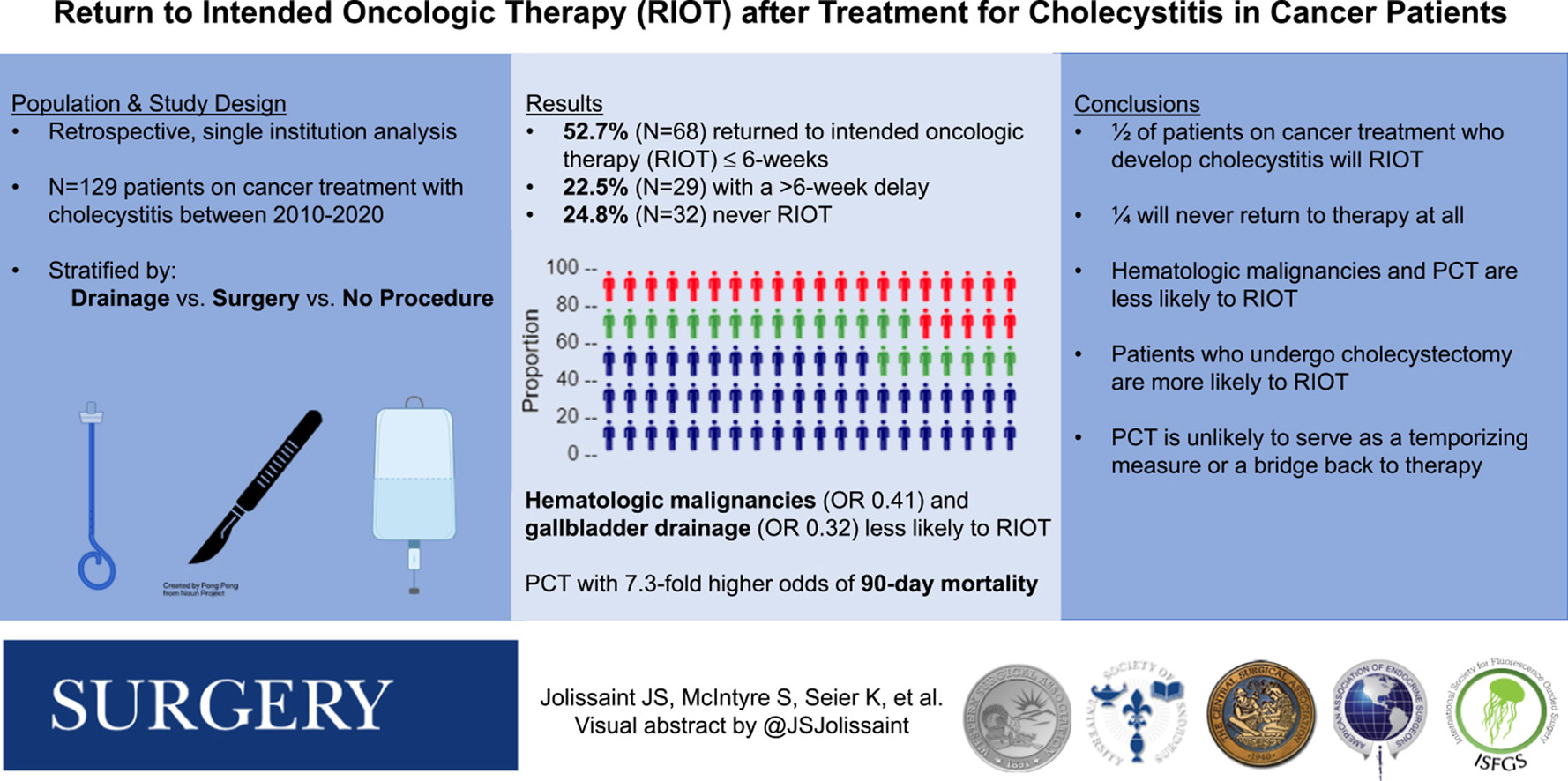
Overall, 52.7% of patients (68/129) returned to cancer-directed treatment within 6 weeks after cholecystitis. Meanwhile, 22.5% (29/129) experienced delays beyond 6 weeks, and 24.8% (32/129) never resumed oncologic therapy. This distribution underscores the serious impact of cholecystitis and its treatment on oncologic care continuity.
Notably, patients with better performance status, as measured by Eastern Cooperative Oncology Group (ECOG) scores of 0-1, were significantly more likely to return within 6 weeks (81.8% vs. 52.5%, P = .023). The type of malignancy influenced outcomes: patients with hematologic malignancies were less likely to resume treatment promptly compared to those with solid or multiple malignancies (OR 0.41, 95% CI 0.17-0.98, P = .044).
The modality of cholecystitis management showed strong associations with treatment resumption. Patients undergoing drainage procedures had a notably lower likelihood of returning to oncologic therapy within 6 weeks (OR 0.32, 95% CI 0.13-0.81, P = .016), compared to those managed surgically or non-procedurally. Of particular interest, only 3 patients who had a percutaneous cholecystostomy tube subsequently underwent interval cholecystectomy, reflecting a very low conversion rate from drainage to definitive surgical management.
This low rate of interval cholecystectomy may reflect a clinical preference for less invasive management due to patients’ fragile condition but might also contribute to prolonged morbidity and delayed oncologic therapy recovery. The findings suggest that percutaneous drainage, while less invasive, may not facilitate early return to cancer therapy as effectively as surgery or other strategies.
Expert Commentary
The study provides important clinical insights into a common but understudied complication in oncology care. Patients with hematologic malignancies possibly have increased susceptibility to complications and prolonged recovery due to immunosuppression and therapy intensity, which may explain their reduced likelihood to resume treatment promptly.
Additionally, while percutaneous cholecystostomy is often favored for high-risk surgical candidates, this management may represent a trade-off, gaining short-term safety at the expense of delayed oncologic care. This challenges clinicians to balance infection control and cancer treatment continuity and could inform patient selection for different cholecystitis therapies.
Limitations of this retrospective study include potential coding inaccuracies, heterogeneity in cancer types and treatments, and single-institution data limiting generalizability. Prospective and multicenter research is warranted to optimize cholecystitis management pathways that minimize oncologic treatment disruption.
Conclusion
Cholecystitis occurring during active cancer treatment significantly impedes timely resumption of intended oncologic therapy, with only about half of patients returning within 6 weeks. Patients with hematologic malignancies and those managed with drainage procedures face higher risks of delayed or discontinued cancer care. The low frequency of interval cholecystectomy after percutaneous drainage suggests it is unlikely to accelerate return to cancer therapy. These findings underscore the need for individualized treatment strategies balancing infection management with preservation of oncologic treatment schedules to improve patient outcomes.
Funding and ClinicalTrials.gov
Not reported in the original study abstract.
References
Jolissaint JS, McIntyre S, Seier K, Gonen M, Sachdeva S, Balachandran V, D'Angelica MI, Drebin JA, Kingham TP, Soares KC, Jarnagin WR, Wei AC. Return to intended oncologic therapy after treatment for cholecystitis in cancer patients. Surgery. 2026 Oct;198:110447. doi: 10.1016/j.surg.2026.110447. Epub 2026 Jul 16. PMID: 42570422; PMCID: PMC13588296.