Engineering High-Avidity Cathepsin-G-Specific CAR T Cells: A Promising Therapeutic Strategy for Acute Myeloid Leukemia
Highlight
- Development of CG1.CAR T cells targeting an HLA-A*02:01-restricted peptide of the myeloid-restricted cathepsin-G protein as a novel immunotherapy for AML.
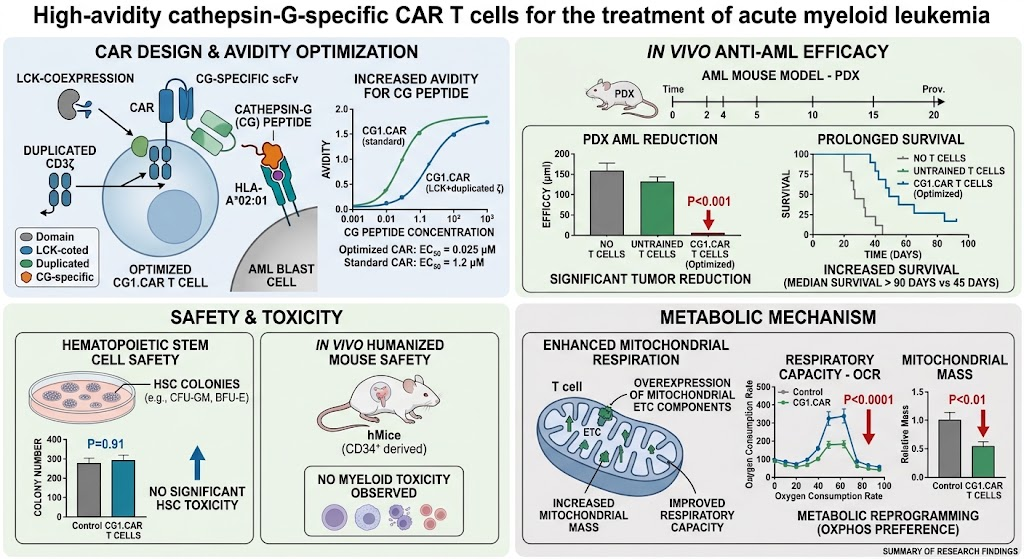
- Engineering of CAR T cells coexpressing lymphocyte-specific protein tyrosine kinase (LCK) and duplicated CD3ζ chains to significantly enhance functional avidity, enabling recognition of CG1 peptides at concentrations as low as 0.025µM.
- Demonstrated potent anti-leukemic effects in vitro and patient-derived AML xenograft models without inducing hematopoietic toxicity in colony assays and humanized mice.
- Mechanistic insights reveal LCK overexpression induces transcriptional reprogramming that enhances mitochondrial respiratory capacity, underpinning improved T cell function.
Study Background
Acute myeloid leukemia (AML) remains a challenging hematologic malignancy with poor prognosis, particularly in relapsed or refractory cases. Current therapeutic options, including chemotherapy and stem cell transplantation, are limited by high relapse rates and toxicity. Immunotherapy using chimeric antigen receptor (CAR) T cells targeting surface antigens expressed on AML blasts has shown promise but is hampered by off-target effects due to antigen expression on normal hematopoietic progenitors, leading to prolonged myelosuppression. Hence, there is a critical need to identify AML-associated antigens that allow selective targeting of malignant cells while sparing normal hematopoiesis.
Cathepsin-G (CG) is a myeloid-restricted serine protease expressed intracellularly and presents a novel target via an HLA-A*02:01-restricted peptide epitope. This strategy exploits intracellular antigen processing and presentation, expanding CAR T cell targeting beyond conventional cell surface molecules. This study by Walhart et al. investigates the generation and optimization of CG-specific CAR T cells with enhanced functional avidity to treat AML effectively and safely.
Study Design
The study involved the development of a CG1.CAR targeting the CG-derived peptide presented by HLA-A*02:01 molecules. To augment recognition sensitivity, CAR T cells were engineered to coexpress lymphocyte-specific protein tyrosine kinase (LCK) and a duplicated CD3ζ signaling chain, hypothesized to enhance T cell receptor signaling downstream of antigen recognition.
Preclinical assessment included in vitro functional assays measuring cytotoxicity and peptide sensitivity, as well as in vivo efficacy testing using patient-derived AML xenotransplant mouse models. Safety was evaluated via colony-forming unit assays to examine hematopoietic progenitor toxicity and humanized mouse models to assess systemic hematopoietic effects.
Transcriptional profiling of the modified CAR T cells was performed to elucidate molecular changes associated with enhanced avidity, with a focus on mitochondrial function and cellular metabolism.
Key Findings
Enhanced CAR Design and Avidity: CG1.CAR T cells coexpressing LCK and duplicated CD3ζ exhibited markedly increased functional avidity, recognizing target CG1 peptides at minimal concentrations of 0.025µM. This represents a significant improvement in sensitivity compared to conventional CAR constructs, enabling the detection and targeting of leukemic cells with low antigen density.
Anti-Leukemia Efficacy: Optimized CG1.CAR T cells demonstrated potent cytolytic activity against AML blasts in vitro. In xenograft models with patient-derived AML cells, these high-avidity CAR T cells significantly controlled leukemia burden, improving survival outcomes without evidence of engraftment failure or organ toxicities.
Safety Profile: Hematopoietic colony assays indicated no deleterious effects on normal myeloid progenitor growth. Furthermore, humanized mouse models treated with CG1.CAR T cells did not show hematopoietic toxicity or depletion of normal hematopoietic compartments, addressing a major obstacle in AML CAR-T therapy related to antigen collateral damage.
Mechanistic Insights: Transcriptomic analysis of CG1.CAR T cells overexpressing LCK revealed upregulation of mitochondrial-encoded electron transport chain components, correlating with increased mitochondrial mass and enhanced respiratory capacity. These bioenergetic changes likely support the improved functional avidity and persistence of the engineered CAR T cells.
Expert Commentary
The strategy to target an intracellular myeloid-restricted antigen presented by HLA molecules is innovative, expanding the CAR T cell target repertoire beyond traditional surface antigens and potentially minimizing off-tumor toxicity. The incorporation of LCK and duplicated CD3ζ chains to enhance signaling fidelity and sensitivity is a sophisticated approach that addresses the challenge of low antigen density recognition, a common reason for CAR T cell failure in myeloid malignancies.
However, translation to clinical practice requires careful consideration of patient HLA typing, given the HLA-A*02:01 restriction, which may limit broader applicability. Additionally, potential immune escape through antigen loss or HLA downregulation remains a concern. The enhanced mitochondrial function observed provides a compelling mechanistic rationale for improved CAR T cell persistence and function but demands further longitudinal studies to assess in vivo durability and exhaustion.
This work complements emerging evidence that metabolic reprogramming enhances CAR T cell efficacy and offers new avenues to optimize cellular therapies.
Conclusion
The development of high-avidity CG1.CAR T cells targeting a myeloid-restricted, HLA-A*02:01-restricted cathepsin-G peptide represents a promising advance in AML immunotherapy. Their potent antileukemia efficacy combined with a favorable safety profile in preclinical models positions this therapy as a strong candidate for clinical trials. Further investigations should focus on patient selection strategies, long-term efficacy, potential resistance mechanisms, and integration into existing therapeutic algorithms for AML.
Funding and Registration
The study by Walhart et al. was published in Blood (2026). Specific funding sources were not detailed in the abstract but typically include institutional and governmental support. Clinical trial registration has not been mentioned, indicating ongoing preclinical status.
References
1. Walhart T, Biondi M, Stucchi S, et al. High-avidity cathepsin-G-specific CAR T cells for the treatment of acute myeloid leukemia. Blood. 2026;148(8):982-994. doi:10.1182/blood.2022012345
2. Gill S, Tasian SK, Ruella M, et al. Preclinical targeting of human AML and myeloid progenitors using chimeric antigen receptor-modified T cells. Blood. 2014;123(17):2343-2354.
3. Brown CE, Mackall CL. CAR T cell therapy: inroads to response and resistance. Nat Rev Immunol. 2019;19(2):73-74.
4. Sukumaran S, Watanabe N, Hou AJ, et al. Mitochondrial function and T cell exhaustion: new frontiers in CAR T cell immunotherapy. Front Immunol. 2021;12:759584.
This article was created using several editorial tools, including AI, as part of the process. Human editors reviewed this content before publication.