Dual-Targeted Anti-BCMA/GPRC5D CAR T-Cell Therapy Shows Promise in Relapsed/Refractory Multiple Myeloma with Extraosseous Extramedullary Disease
Highlight
- Anti-BCMA/GPRC5D bispecific CAR T cells elicit a 97% overall response rate in relapsed/refractory multiple myeloma with extraosseous extramedullary disease.
- Stringent complete response and measurable residual disease negativity were observed in a substantial subset of patients.
- The median progression-free survival was 5.8 months with manageable safety profile predominantly featuring hematologic toxicities and mild-to-moderate cytokine release syndrome.
Study Background: Clinical Challenge of Extramedullary Multiple Myeloma
Multiple myeloma (MM) represents a hematologic malignancy characterized by clonal proliferation of plasma cells predominantly within the bone marrow. Although therapeutic advances have improved outcomes, a subset of patients develop relapsed or refractory disease (RRMM), which remains challenging to treat. Extramedullary disease (EMD), especially extraosseous involvement wherein tumor masses manifest outside the bone marrow and skeletal system, portends a particularly adverse prognosis with limited effective treatment options. This phenotype often reflects aggressive biology and resistance to conventional therapies, highlighting a critical unmet need for novel targeted interventions.
Chimeric antigen receptor (CAR) T-cell therapies directed against B-cell maturation antigen (BCMA) have revolutionized treatment for RRMM. However, durability of responses in patients with EMD remains suboptimal, partly due to antigen heterogeneity and immune evasion. GPRC5D, a recently identified antigen expressed on myeloma cells distinct from BCMA, emerged as a promising co-target. Bispecific CAR T cells engineered to recognize both BCMA and GPRC5D potentially mitigate antigen escape and improve therapeutic efficacy in challenging subsets such as extraosseous EMD.
Study Design
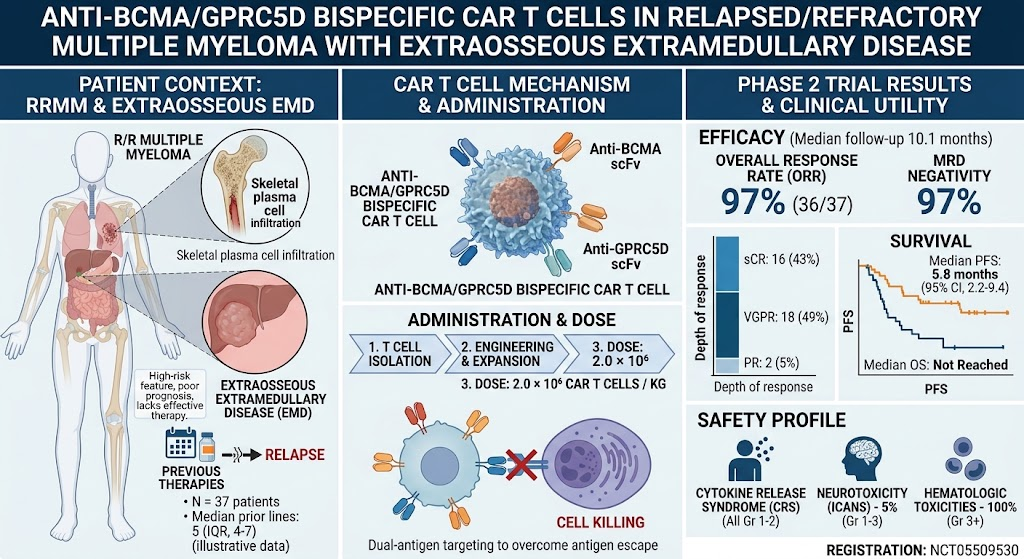
This open-label, single-arm phase 2 clinical trial (NCT05509530) enrolled 37 patients with relapsed or refractory multiple myeloma exhibiting extraosseous extramedullary disease. Eligible patients had received prior lines of therapy and lacked alternative effective treatments. The intervention consisted of a single infusion of anti-BCMA/GPRC5D bispecific CAR T cells at a dose of 2.0 car T cells per kilogram. The primary endpoints encompassed response rates assessed per International Myeloma Working Group criteria, measurable residual disease (MRD) negativity, progression-free survival (PFS), and safety evaluations.
Key Findings
At a median follow-up of 10.1 months (interquartile range, 6.4 to 19.1), the trial demonstrated remarkable activity: 97% (36/37) of patients achieved an overall response, and all responders were MRD-negative. A stringent complete response (sCR) was documented in 43% (16 patients), underscoring deep disease eradication. Median progression-free survival was 5.8 months (95% CI, 2.2-9.4 months), while median overall survival was not reached at the time of reporting, indicating durable outcomes in some.
The safety profile was consistent with expected CAR T-cell therapy toxicities. All patients experienced hematologic toxicities of grade 3 or higher, excluding lymphopenia, representing the most common severe adverse events. Cytokine release syndrome (CRS) occurred in 73% of patients, but notably all were grade 1 or 2, manageable with supportive care and without escalation to higher-grade events. Immune effector cell-associated neurotoxicity syndrome (ICANS) was less frequent, seen in only 5% with grades 1 and 3 events. No new safety signals emerged.
These results demonstrate that targeting dual antigens BCMA and GPRC5D via CAR T cells can achieve high response rates, deep remissions, and manageable toxicity in a high-risk subset of MM patients with extraosseous extramedullary dissemination.
Expert Commentary
The study by Zhou et al. represents a significant advance in the field of cellular immunotherapy for multiple myeloma complicated by difficult-to-treat extramedullary involvement. Historically, EMD in MM has been associated with poor prognosis due to drug resistance and the sanctuary sites posing therapeutic challenges. Conventional anti-BCMA CAR T therapies have limited success in controlling EMD, likely due to antigen heterogeneity and immune evasion.
Introduction of a bispecific CAR targeting both BCMA and GPRC5D addresses this key limitation by providing broader antigen recognition, reducing tumor escape. The remarkably high response rates and MRD negativity in this refractory population suggest enhanced cytotoxic efficacy. The favorable safety profile with predominantly low-grade CRS and limited neurotoxicity adds to the clinical appeal.
However, despite encouraging initial responses, the median PFS of under 6 months indicates that relapse remains a concern. This likely reflects complex tumor biology and microenvironmental immune suppression in EMD. Future research should explore combination strategies or sequential targeting to improve duration of response.
Generalizability may be limited by single-arm design and relatively short follow-up. Larger, randomized studies comparing dual-target CAR T cells with current standards are warranted to define long-term benefits and optimal patient selection.
Conclusion
In summary, dual-targeted anti-BCMA/GPRC5D CAR T-cell therapy offers a promising new treatment avenue for patients with relapsed/refractory multiple myeloma complicated by extraosseous extramedullary disease, a group with dire prognosis and limited options. The high response rates, achievement of deep remissions including MRD negativity, and manageable safety profile highlight the therapeutic potential of this bispecific CAR T-cell approach. Nonetheless, further investigation to enhance response durability and confirm these findings in broader populations is needed to solidify its place in clinical practice.
Funding and Clinical Trial Registration
This phase 2 trial was supported by institutional and funding sources detailed in the original publication. The ongoing study is registered at ClinicalTrials.gov under the identifier NCT05509530.
References
1. Zhou D, Qi Y, Ma S, et al. Anti-BCMA/GPRC5D CAR T cells in patients with relapsed or refractory multiple myeloma who have extraosseous extramedullary disease. Blood. 2026 Aug 13;148(7):831-840. PMID: 42166352.
2. Munshi NC, Anderson LD Jr, Shah N, et al. Idecabtagene vicleucel in relapsed and refractory multiple myeloma. N Engl J Med. 2021 Mar 25;384(8):705-716.
3. Smith EL, Harrington KH, Staehr M, et al. GPRC5D as a target for antibody-drug conjugates in multiple myeloma. Blood Cancer J. 2020 Apr 15;10(4):39.
4. Lonial S, Lee HC, Badros A, et al. Belantamab mafodotin for relapsed or refractory multiple myeloma: A review. Future Oncol. 2021;17(23):3059-3073.
This article was created using several editorial tools, including AI, as part of the process. Human editors reviewed this content before publication.