Cervical Thymectomy During Parathyroidectomy Improves Cure Rates in MEN1 Patients with Primary Hyperparathyroidism
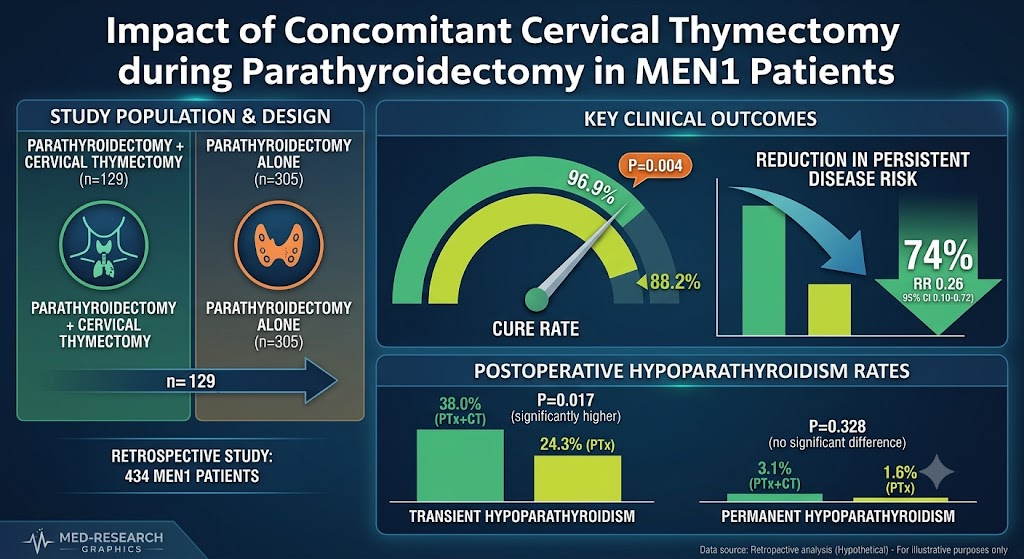
Cervical thymectomy added to parathyroidectomy for primary hyperparathyroidism in MEN1 patients resulted in a 74% reduction in the risk of persistent disease (RR 0.26, 95% CI 0.10–0.72).
Cure rates were significantly higher with thymectomy (96.9% vs 88.2%, P = .004).
Transient hypoparathyroidism was more common with thymectomy (38.0% vs 24.3%, P = .017), but permanent hypoparathyroidism rates were not significantly different.
Findings support cervical thymectomy as a standard component of surgery for MEN1-related hyperparathyroidism.
Study Snapshot
Design: Retrospective cohort study using the TriNetX global research network (over 130 million patients).
Population: 434 patients with multiple endocrine neoplasia type 1 (MEN1) undergoing parathyroidectomy for primary hyperparathyroidism.
Exposure: Cervical thymectomy added to parathyroidectomy (129 patients) vs parathyroidectomy alone (305 patients).
Primary outcomes: Cure, persistent and recurrent disease, reoperation, transient and permanent hypoparathyroidism.
Key result: Higher cure rate (96.9% vs 88.2%) with thymectomy; persistent disease risk reduced by 74%.
Limitations: Retrospective design, potential selection bias, database limitations, unspecified follow-up duration.
Why This Study Matters
Patients with multiple endocrine neoplasia type 1 (MEN1) almost invariably develop primary hyperparathyroidism, often requiring surgical intervention. Parathyroidectomy is the standard treatment, but the role of adding cervical thymectomy has been debated. Some single-institution reports suggested no benefit, while others advocated for routine thymectomy to reduce the risk of recurrence from ectopic or supernumerary parathyroid tissue in the thymus. This study leverages a large multicenter database to provide evidence on the outcomes of this adjunct procedure.
How the Study Was Conducted
Researchers conducted a retrospective analysis using the TriNetX research platform, a global collaborative network encompassing more than 130 million patients. They identified 434 patients with a diagnosis of MEN1 who underwent parathyroidectomy for primary hyperparathyroidism. Of these, 129 patients had cervical thymectomy performed at the same time, while 305 had parathyroidectomy alone. The two groups were compared for rates of cure (defined as normocalcemia at last follow-up), persistent disease, recurrent disease, reoperation, and postoperative hypoparathyroidism (transient and permanent).
What the Researchers Found
The addition of cervical thymectomy was associated with significantly higher cure rates: 96.9% in the thymectomy group versus 88.2% in the parathyroidectomy-only group (P = .004). The relative risk of persistent disease was 0.26 (95% confidence interval 0.10–0.72), a 74% reduction. Transient hypoparathyroidism occurred more frequently in the thymectomy group (38.0% vs 24.3%, P = .017), but the rate of permanent hypoparathyroidism did not differ significantly (3.1% vs 1.6%, P = .328). There were no significant differences in rates of reoperation or recurrent disease within the available follow-up period.
What the Findings May Mean
These results indicate that routine cervical thymectomy during parathyroidectomy for MEN1-associated hyperparathyroidism improves cure rates without a lasting increase in the risk of permanent hypoparathyroidism. The transient increase in hypoparathyroidism likely reflects more extensive dissection but appears to resolve in most patients. The findings challenge recent single-institution reports that found no benefit and support the longstanding recommendation to include cervical thymectomy as part of the standard surgical procedure for MEN1 patients.
Strengths and Limitations
Strengths: The study uses a large, multi-institutional database, which enhances generalizability compared with single-center analyses. The TriNetX platform provides a diverse population and standardized data extraction.
Limitations: The retrospective design introduces potential selection bias; the decision to perform thymectomy may have been influenced by patient or disease characteristics not fully captured. The database does not specify the duration or completeness of follow-up, which could affect the detection of recurrent disease or permanent hypoparathyroidism. Additionally, the study lacks details on the extent of parathyroid resection (subtotal vs total) and the number of glands removed, which may confound outcomes. Finally, as a database study, coding errors and incomplete records are possible.
Implications for Practice and Research
The authors conclude that cervical thymectomy should be considered a standard component of care for MEN1 patients undergoing parathyroidectomy for primary hyperparathyroidism. This study provides large-scale evidence supporting the practice and may help settle the debate raised by earlier smaller reports. Future prospective studies with long-term follow-up and standardized surgical protocols would be valuable to confirm these findings and clarify the optimal extent of thymectomy.
Funding, Disclosures, and Registration
The original article did not specify funding, conflicts of interest, or registration details. The study was published in Surgery in 2026.
References
Bashumeel YY, Abdelmaksoud A, Omar M, et al. Impact of cervical thymectomy on multiple endocrine neoplasia type 1 patients undergoing parathyroidectomy for primary hyperparathyroidism. Surgery. 2026;195:110261. PMID: 42140757.
This article was created using several editorial tools, including AI, as part of the process. Human editors reviewed this content before publication.