We use cookies

Our website uses essential cookies and, with your consent, additional cookies to measure performance and improve our services. Cookie Policy.

You can change your choice at any time.

MMedXYNews
HomeVideos
MedXY AI/MedXY News/Section: Hematology-Oncology

Breast Implant-Associated Anaplastic Large Cell Lymphoma: Insights into Cellular Diversity, Immune Suppression, and Therapeutic Opportunities
MedXY Editorial Team•Aug 5, 2026•Hematology-Oncology
immune suppressionTumor MicroenvironmentBreast ImplantsBIA-ALCLT cell lymphoma

Highlight

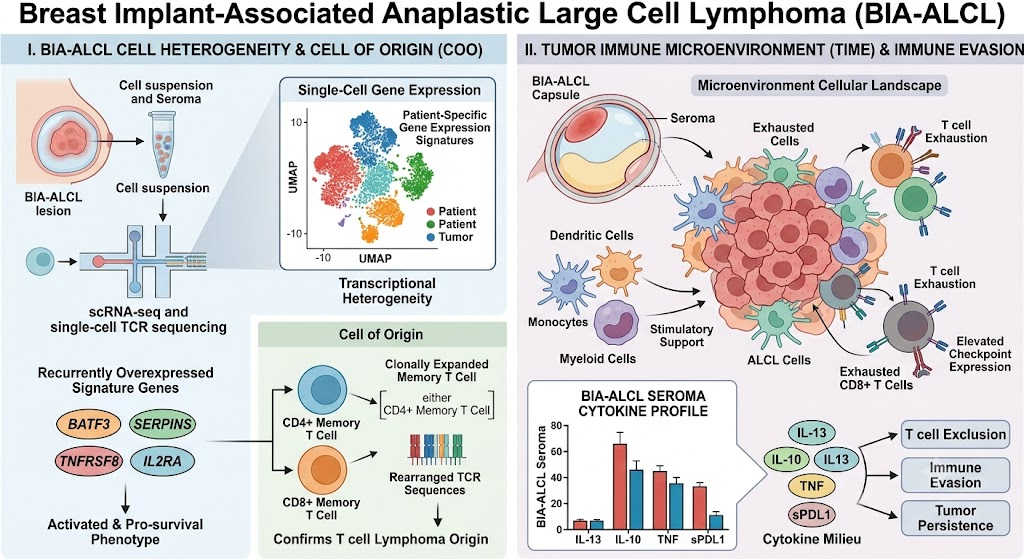
  • BIA-ALCL is a heterogeneous T cell lymphoma arising in women with textured breast implants with variable gene expression profiles.

  • The cell of origin is a memory CD4+ or CD8+ T cell identified by unique TCR rearrangement and gene expression patterns.

  • The tumor immune microenvironment (TIME) is complex, featuring distinct myeloid populations and elevated immunosuppressive cytokines including IL-10, IL-13, and TNF.

  • BIA-ALCL induces T cell exhaustion and immune evasion, revealing potential novel immunotherapeutic targets for advanced disease.

Study Background

MedXY registered readers

Sign in free to continue reading

Create or use your MedXY account to unlock the complete article.

This article was created using several editorial tools, including AI, as part of the process. Human editors reviewed this content before publication.

Related articles

Open language-specific specialty feeds and department pages.

Unveiling the Molecular Evolution from Primary Gastric Cancer to Peritoneal Metastases: Implications for Targeted Surgical OncologyThis study elucidates transcriptomic differences between primary gastric cancers and peritoneal metastases, revealing distinct tumor microenvironments and molecular pathways, highlighting potential targets for improved diagnosis and therapySep 5, 2026Distinct Myeloid Landscapes Define Prognostic Niches in Extranodal NK/T-Cell LymphomaSpatial multimodal profiling reveals two macrophage-defined ENKTL subgroups with distinct tumor-myeloid interactions influencing prognosis and potential immunotherapy targets.Aug 30, 2026Targeting NSUN6 Deficiency to Overcome Immune Suppression in Pancreatic Cancer: Insights into the KDM5A-CCL2-Macrophage AxisNSUN6 deficiency in pancreatic cancer promotes immune suppression by enhancing immunosuppressive macrophage infiltration via the KDM5A-CCL2 axis, leading to resistance to immune checkpoint blockade; targeting this pathway offers a promisingAug 21, 2026
Loading comments...
MedXY briefing

Get the free newsletter

Evidence-led clinical news, trends, and analysis—delivered to your inbox.

Ask MedXY AI

Most popular

Intimate Health
Five Benefits for Women Continuing Sexual Activity After Menopause
Intimate Health
Why Some Women Have a Strong Sex Drive—And Why Men Shouldn't Worry About It
Nursing & care
How often should a couple have sex?
Intimate Health
Classic Intimacy Recommendations: How to Help Women Reach Orgasm and Enjoy Mutual Pleasure
Intimate Health
What Makes a Woman "Physiologically Addicted" Is Never Money, But These Two Relationship Qualities
© 2026 MedXY
Contact usAbout usPrivacy PolicyMedXY story
Enhanced Traceability of Breast Implants: Evaluating the Dutch Breast Implant Registry’s Superiority Over Electronic Patient Records in a Test Recall
A test recall study demonstrated that the Dutch Breast Implant Registry significantly outperforms electronic patient records alone in tracing breast implants, underlining the critical role of comprehensive registries in patient safety.
Jun 30, 2026
Targeting NEK9 to Overcome Immunotherapy Resistance in Hepatocellular Carcinoma by Reprogramming the Tumor MicroenvironmentNEK9 upregulation in hepatocellular carcinoma promotes immune evasion by enhancing PD-L1 expression and recruiting suppressive myeloid cells. Novel NEK9 inhibitors synergize with PD-L1 blockade, remodeling the tumor microenvironment and impJun 27, 2026
Fibrosis-Driven Activation of Schwann Cells in Pancreatic Cancer: Unraveling the Nuclear Mechanosensing PathwayPancreatic fibrosis activates Schwann cells via nuclear mechanosensing, promoting a protumorigenic environment that enhances pancreatic cancer progression, offering novel microenvironment-targeted therapeutic insights.Jun 25, 2026