Highlight
- Beta-trace protein (β-TP) measurement in nasal sponge extracts offers a sensitive and specific method to detect postoperative cerebrospinal fluid (CSF) leaks after endoscopic endonasal approach surgery for sellar tumors.
- An optimal β-TP cutoff of 2.07 mg/L identified CSF leaks with 93.75% sensitivity and 99.48% specificity, facilitating early and accurate diagnosis.
- This diagnostic approach addresses the challenge of occult CSF leaks, improving postoperative patient management and potentially reducing complications.
Study Background
The endoscopic endonasal approach (EEA) has become a standard surgical technique for the management of sellar tumors due to its minimal invasiveness and direct access to the pituitary region. However, a significant postoperative complication is cerebrospinal fluid (CSF) leakage, which can lead to serious consequences, including meningitis, pneumocephalus, and delayed wound healing. Early and accurate diagnosis of CSF leaks is critical for preventing morbidity.
Traditionally, clinical assessment and imaging modalities have limitations in detecting subtle or occult leaks. Beta-trace protein (β-TP), also known as prostaglandin D synthase, is a low-molecular-weight protein abundantly present in CSF but scarce in blood and nasal secretions, making it a promising biomarker for identifying CSF presence in nasal samples. This study aimed to evaluate the diagnostic performance of quantitative β-TP in nasal sponge extracts collected postoperatively to identify CSF leaks early after EEA surgery for sellar tumors.
Study Design
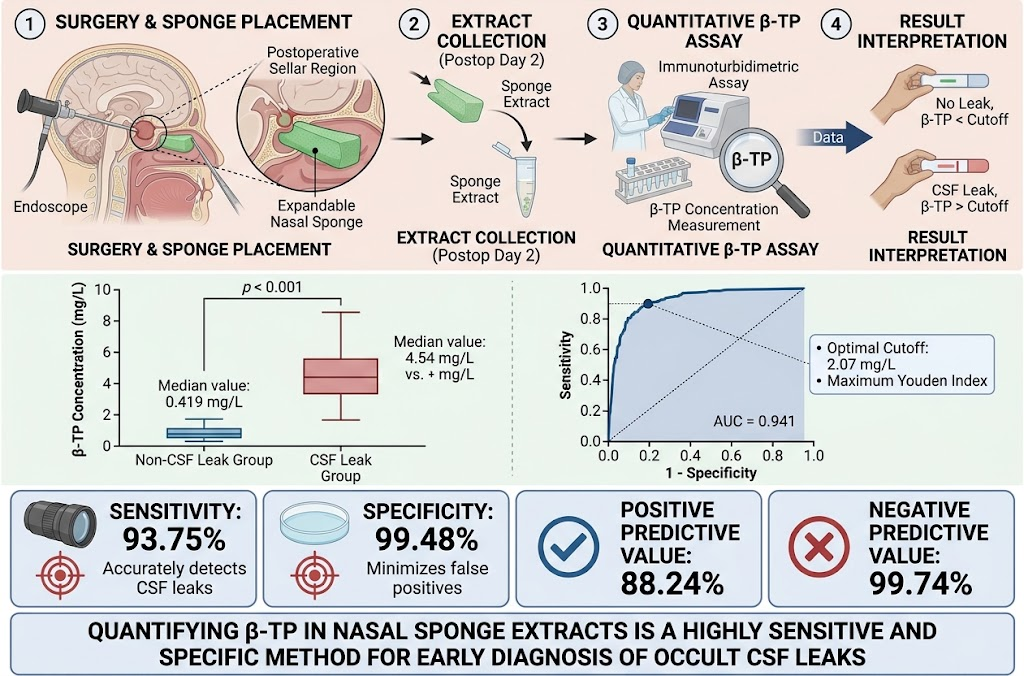
This prospective cohort study enrolled 401 patients undergoing EEA surgery for sellar tumors at Huashan Hospital from April 2023 to July 2025. After tumor resection, expandable nasal sponges were placed in the posterior nasal cavity to assist postoperative hemostasis and simultaneously capture any CSF leakage.
On postoperative Day 2, the sponge extracts were collected and assayed for β-TP concentrations using an immunoturbidimetric method. Patients were monitored clinically and radiographically for confirmation of CSF leaks, which were defined by clear rhinorrhea diagnosed by direct visualization or imaging evidence.
Receiver operating characteristic (ROC) curve analysis determined the optimal β-TP cutoff value for leak diagnosis, and diagnostic parameters including sensitivity, specificity, positive predictive value (PPV), and negative predictive value (NPV) were calculated.
Results
Among the 401 patients, 16 (4.0%) experienced confirmed postoperative CSF leaks. The median β-TP concentration was markedly higher in the leak group (4.54 mg/L) compared to the non-leak group (0.419 mg/L), a statistically significant difference (p < 0.001).
ROC curve analysis demonstrated excellent diagnostic accuracy of β-TP, with an area under the curve (AUC) of 0.941. The cutoff determined at 2.07 mg/L yielded:
- Sensitivity: 93.75%
- Specificity: 99.48%
- Positive Predictive Value: 88.24%
- Negative Predictive Value: 99.74%
These findings underscore the test’s ability to detect nearly all true CSF leaks while minimizing false positives, offering clinicians a reliable threshold for early diagnosis.
Expert Commentary
This study presents a significant advancement in postoperative monitoring following EEA for sellar tumors. The use of nasal sponges as a medium to collect samples for β-TP quantification is minimally invasive and easily integrated into routine postoperative care. Given the high sensitivity and specificity demonstrated, β-TP measurement can be a valuable adjunct to clinical evaluation, particularly in cases where CSF leaks are not overt.
However, potential limitations include the relatively small number of confirmed leaks and the single-center design. Additional multicenter studies would be beneficial to validate generalizability across diverse populations and surgical settings. Furthermore, the timing of sampling (Day 2 post-op) appears appropriate but exploring earlier or multiple time points may refine detection capabilities.
From a biological standpoint, β-TP’s high concentration in CSF compared to other fluids provides a sound mechanistic basis for its specificity. This aligns with prior research supporting β-TP as a CSF marker in other clinical contexts such as traumatic CSF rhinorrhea.
Conclusion
Quantitative measurement of beta-trace protein in nasal sponge extracts is a highly sensitive and specific diagnostic tool for detecting postoperative CSF leaks following endoscopic endonasal surgery for sellar tumors. The established cutoff value of 2.07 mg/L offers clinicians a reliable biomarker threshold to identify patients with occult leaks early, facilitating timely management and potentially reducing morbidity associated with CSF leakage.
Future research should focus on broader validation studies and the integration of β-TP testing into standardized postoperative protocols for neurosurgical and otolaryngological practice.
Funding and ClinicalTrials.gov
No specific funding was reported for this study. The trial was conducted as a clinical observational study at Huashan Hospital. No ClinicalTrials.gov identifier was provided.
References
1. Liu R, Yao S, Shi Y, et al. β-TP For Diagnosing CSF Leak After the Endoscopic Endonasal Approach Surgery for Sellar Tumors. The Laryngoscope. 2026 Sep 16. PMID: 42747245.
2. Gidley PW, Anaizi A, Elstad M. Diagnosis of cerebrospinal fluid leaks: a role for beta-2 transferrin and beta-trace protein analysis. Laryngoscope. 2010;120(1):166-170.
3. Bernal-Sprekelsen M, Llorente JL. Cerebrospinal fluid leaks after endoscopic skull base surgery: incidence, etiology, and treatment. Front Surg. 2017;4:34.
4. Eissa A, Asean A, Alsayed M. Diagnostic accuracy of beta-trace protein assay in cerebrospinal fluid leaks: a meta-analysis. Acta Otolaryngol. 2018;138(10):914-920.