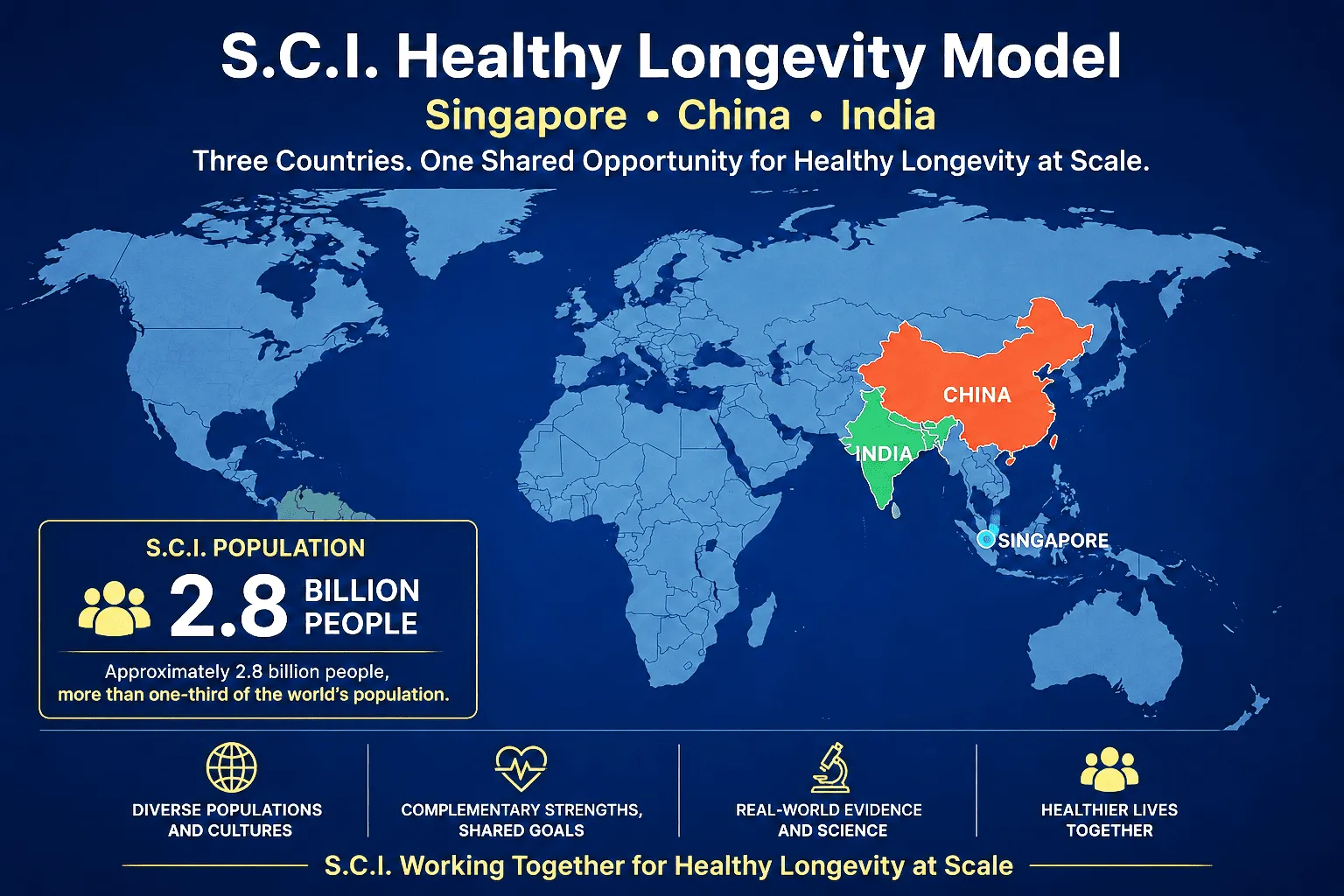
APLMS launched a pilot S.C.I. Healthy Longevity Model covering Singapore, China, and India on October 3–4.
The three countries represent more than 2.8 billion people, about one-third of humanity.
The proposed model emphasizes mobility, cognition, independence, chronic disease reduction, delayed disability, and extended healthspan.
Aging biomarkers and monitoring data are described as auxiliary tools, not the primary definition of healthy longevity.
A planned real-world evidence platform, called the Super Highway Project in the source, aims to compare and validate interventions across populations.
No clinical trial efficacy, safety, or registry results were reported in the source.
Practice snapshot: S.C.I. Healthy Longevity Model
Initiative: APLMS pilot for Singapore, China, and India.
Population context: More than 2.8 billion people across the three countries.
Stated focus: Functional independence, cognition, mobility, chronic disease prevention, delayed disability, and healthspan.
Planned infrastructure: Healthy Longevity Real-World Evidence and Translational Research Collaboration Network Platform, also called the Super Highway Project.
Evidence status: Framework and summit announcement only; no intervention outcomes reported.
What APLMS launched—and what the source does not report
On October 3–4, the Asia-Pacific Longevity Medicine Society, referred to in the source as APLMS, created and launched a pilot called the S.C.I. Healthy Longevity Model—the Singapore–China–India Healthy Longevity Model. The source describes it as a collaboration across three countries with a combined population of more than 2.8 billion people, about one-third of humanity. The stated purpose is not to introduce another theory of aging but to test how scientific progress in longevity medicine can reach ordinary daily life and improve healthspan, independence, and disease prevention.
This is not a clinical trial report. The source does not provide randomization, comparator, sample size, follow-up, primary or secondary endpoints, effect estimates, confidence intervals, p values, adverse events, or registry information. It also does not report funding or conflict-of-interest details. The initiative should therefore be read as an expert summit and organizational announcement—a framework for future real-world evidence—not as proof that any intervention extends healthspan.
Why the model prioritizes function over biological age alone
Experts at the summit argued that changes in aging-related indicators do not necessarily mean a person has become truly healthier or worse. Biomarkers and monitoring data remain important, but the S.C.I. model treats them as auxiliary tools rather than the defining endpoint of healthy longevity.
Instead, the proposed assessment focuses on practical questions:
Can older adults walk better?
Can they maintain clear cognition?
Can they continue to live independently?
Are chronic diseases reduced or avoided?
Is disability delayed?
Is healthspan genuinely extended with vitality?
For clinicians, this shifts the conversation from laboratory or biomarker improvement alone toward function, independence, and disease-free or disability-free time. These are familiar domains in geriatric and preventive care, but the source does not specify how they will be measured, which instruments will be used, or how success will be defined.
Three countries, three real-world settings
S.C.I. does not aim to identify one best longevity model. According to the source, it aims to compare practice across three countries and determine which principles can be shared and which interventions must be localized or adapted for different populations and cultures.
Singapore
Singapore is described as having a relatively mature public health and medical service system, with foundations and research capacity in precision medicine, healthy longevity science, and disease prevention.
China
China brings a very large population, a rapidly developing digital health system, and a setting where modern medicine and traditional health culture coexist. The source presents this as a unique environment for large-scale health optimization management and real-world research.
India
India is described as having a highly diverse population, diet, family, and community structure. Traditional health concepts, including Ayurveda, have long emphasized diet, sleep, exercise, and daily lifestyle. Alongside modern medicine and digital health, this creates another environment for observing healthy longevity practices.
The source does not report any country-specific interventions, outcome data, or implementation results. The comparison is a planned activity, not a completed study.
From randomized trials to real-world evidence
The source acknowledges that randomized controlled trials remain an important method for evaluating the safety and efficacy of interventions in longevity medicine. However, it argues that health does not occur in a laboratory. Healthspan is shaped over decades by diet, exercise, sleep, social relationships, family environment, community participation, life goals, and access to basic preventive medical services.
To study these factors in context, S.C.I. plans to establish a Healthy Longevity Real-World Evidence and Translational Research Collaboration Network Platform, referred to in the source as the Super Highway Project. The stated goal is to observe and validate the actual effects of healthy longevity interventions in different populations and gradually form comparable common indicators, research methods, and implementation pathways.
This is a reasonable aspiration, but the source does not describe the platform's governance, data standards, intervention protocols, or methods for handling confounding. Real-world evidence can complement trials, but it does not automatically replace randomized evidence for causal questions. Readers should watch for prespecified protocols, harmonized outcome definitions, and transparent analysis plans as the initiative develops.
Moving disease prevention out of the waiting room
Another central aim is to move healthy longevity beyond a small number of high-end longevity clinics and specialized service institutions. The source argues that public-health meaningful longevity should not serve only people who actively seek longevity medical care. Validated methods need to enter ordinary communities, workplaces, families, and individuals.
The model therefore raises practical questions that matter for health systems and clinicians:
Can ordinary people access the intervention?
Can they maintain it long term?
Is it culturally acceptable across different populations?
Can the current healthcare system support it?
Does it ultimately improve health outcomes?
These questions are especially important because many longevity interventions are discussed without evidence on scalability, adherence, cost, or equity. The source does not provide answers, but it places these considerations at the center of the proposed model.
What would count as success?
The source states that because Singapore, China, and India together represent about one-third of the global population, even a small improvement in healthspan could have considerable public-health impact if scaled across 2.8 billion people. That framing is plausible but also demands caution: small average effects can be meaningful at population scale, yet they must be measured reliably and achieved without widening health inequalities.
The APLMS President, identified in the source as Dr. Shi, emphasized that S.C.I. is not seeking a unified longevity formula. Instead, the aim is to build a practical, culturally appropriate, scientifically based, and scalable healthy longevity model, continuously tested through real-world evidence and translated into better disease prevention, healthier daily life, and better health outcomes.
The source concludes that the real examination room for longevity medicine is not only the laboratory or the longevity clinic, but ordinary people's decades of real and everyday life. For clinicians, that means keeping the focus on function, independence, prevention, and long-term outcomes—while remaining clear about what is still unproven.