Advancing Diagnosis in Myeloproliferative Neoplasms: Non-invasive Multiparametric Profiling of ET, Premyelofibrosis, and Overt Myelofibrosis
Highlight
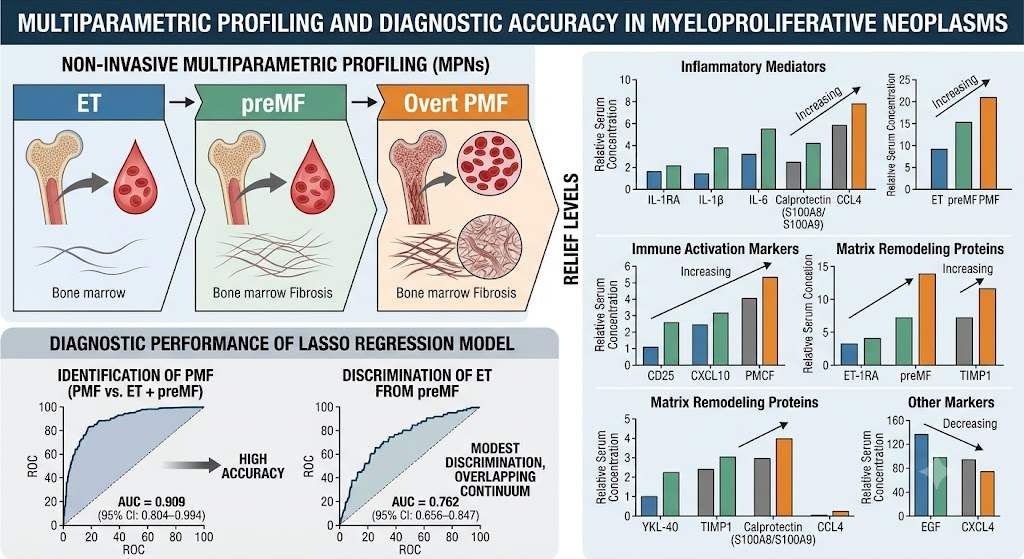
This prospective study analyzed 128 patients with essential thrombocythemia (ET), premyelofibrosis (preMF), and overt primary myelofibrosis (PMF) using non-invasive biomarker panels. Significant differences in inflammatory, immune activation, and matrix remodeling markers help distinguish PMF from ET and preMF. The results support a pathophysiological continuum between these MPN subtypes.
Study Background
Myeloproliferative neoplasms (MPNs) are clonal hematopoietic stem cell disorders characterized by excessive proliferation of one or more myeloid lineages. Essential thrombocythemia (ET) and primary myelofibrosis (PMF) represent distinct entities with unique clinical features and prognoses. However, the 2016 WHO classification introduced prefibrotic myelofibrosis (preMF) as a separate diagnostic category, highlighting the challenges of differentiating it precisely from ET and overt PMF. Reliable, minimally invasive methods for patient stratification remain an unmet need in clinical practice.
Study Design
In a prospective cohort study, 128 patients were enrolled and classified based on WHO criteria into ET (n=44), preMF (n=53), and PMF (n=21). The study comprehensively assessed non-invasive parameters, including inflammatory cytokines, immune activation markers, and extracellular matrix regulators in peripheral blood. A two-step Lasso regression model was applied with internal bootstrap validation to evaluate the discriminatory power of these multiparametric biomarkers in distinguishing the disease entities. Genomic mutational profiling provided context regarding increasing molecular complexity across the disease spectrum.
Key Findings
The mutational landscape revealed increasing complexity from ET through preMF to PMF, consistent with disease progression. Significant differential expression was identified in key biomarkers:
Inflammatory mediators such as IL-1RA, IL-1β, IL-6, calprotectin (S100A8/S100A9), and CCL4 showed increased levels in PMF versus ET, with preMF closer to PMF profiles.
Immune activation markers, including CD25 and CXCL10, were elevated in PMF, distinguishing it from ET.
Matrix remodeling proteins, YKL-40 and TIMP1, increased with fibrosis severity, highlighting their role as fibrosis indicators.
Conversely, epidermal growth factor (EGF) and CXCL4 were decreased in PMF compared to ET and preMF.
The two-step Lasso regression model achieved high accuracy in identifying PMF patients with an area under the curve (AUC) of 0.909 (95% CI: 0.804–0.994). Discrimination between ET and preMF was more modest with an AUC of 0.762 (95% CI: 0.656–0.847), reflecting an overlapping biological continuum.
These findings underscore the value of multi-biomarker assessments to non-invasively identify PMF and assist differentiation from ET and preMF, although the latter remain challenging due to overlapping pathophysiology.
Expert Commentary
The results align with evolving concepts that preMF represents an intermediate phenotype between ET and overt PMF, rather than a completely distinct entity. The distinct inflammatory and immune activation signatures in PMF corroborate its aggressive clinical course and fibrotic marrow remodeling. These non-invasive parameters could complement bone marrow biopsy and genetic profiling for diagnosis and monitoring. However, the limitations inherent to peripheral biomarker variability and overlapping profiles warrant cautious clinical interpretation, emphasizing the need for integration with morphological and molecular diagnostics.
Future studies should explore longitudinal biomarker dynamics to assess prediction of disease progression and therapeutic response. Moreover, validation in larger cohorts and diverse populations will be critical to enhance generalizability. Mechanistically, the role of inflammatory mediators and matrix regulators underscores potential therapeutic targets to modulate fibrosis.
Conclusion
This study demonstrates that non-invasive multiparametric profiling can effectively discriminate overt PMF from ET and preMF, offering a promising diagnostic adjunct for clinicians. The gradient of biomarker expression supports the view of a pathophysiological spectrum from ET to PMF with preMF as an intermediate state. While accuracy for distinguishing ET from preMF remains limited, these findings provide a framework for refining diagnostic criteria and personalizing management strategies in MPNs. Further research integrating biomarker data with genomic and histopathological analyses is warranted to improve diagnostic precision and patient outcomes.
Funding and ClinicalTrials.gov
The original study did not specify funding or clinical trial registration details. Future publications should clarify these aspects to enhance transparency and reproducibility.
References
Arber DA, Orazi A, Hasserjian R, et al. The 2016 revision to the WHO classification of myeloproliferative neoplasms. Blood. 2016;127(20):2391-2405.
Tefferi A, Vannucchi AM, Barbui T. Primary myelofibrosis: 2021 update on diagnosis, risk-stratification and management. Am J Hematol. 2021;96(1):145-162.
Barbui T, Thiele J, Gisslinger H, et al. Prefibrotic myelofibrosis: a new myeloproliferative neoplasm and its diagnostic criteria. Blood Cancer J. 2017;7(3):e498.
Passamonti F, Rumi E, Pungolino E, et al. Dynamic prognostic model to predict survival in primary myelofibrosis. J Clin Oncol. 2010;28(19):3760-3765.
Hasselbalch HC. Perspectives on chronic inflammation in essential thrombocythemia, polycythemia vera, and myelofibrosis: is chronic inflammation a trigger and driver of clonal evolution and development of accelerated atherosclerosis and second cancer? Blood Rev. 2012;26(4):173-179.
This article was created using several editorial tools, including AI, as part of the process. Human editors reviewed this content before publication.