Adjuvant Chemotherapy in Distal Bile Duct Carcinoma: Insights from Real-World German Cancer Registry Data
Highlight
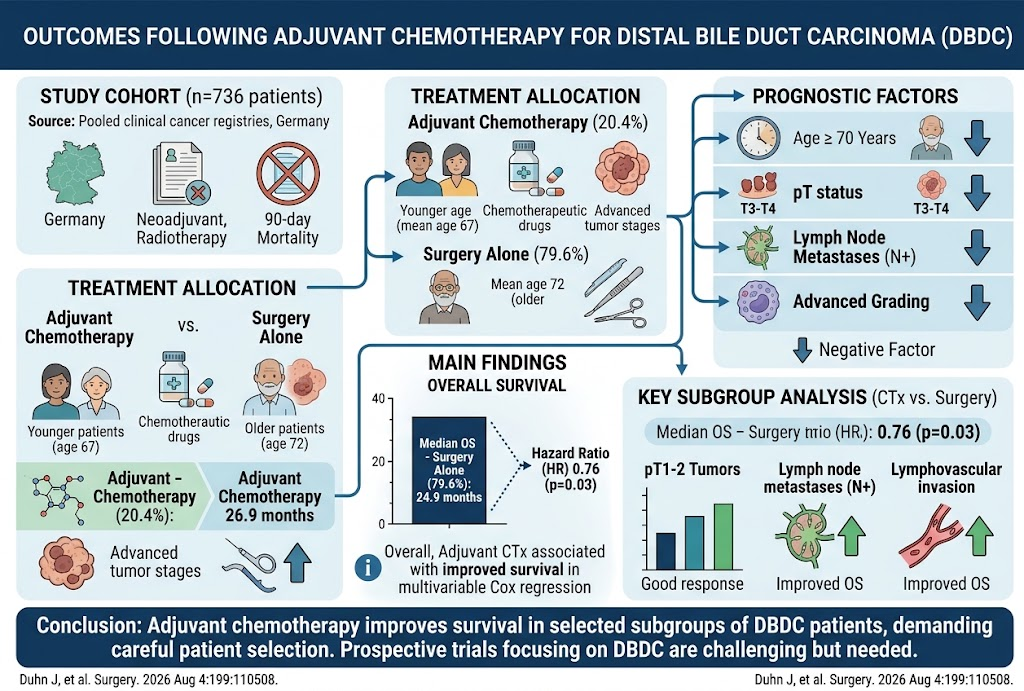
- Adjuvant chemotherapy was administered in 20.4% of patients with distal bile duct carcinoma in a large German cohort.
- Overall, adjuvant chemotherapy did not significantly improve median survival in unadjusted analyses but was an independent positive prognostic factor in multivariable models.
- Subgroup analyses revealed survival benefits particularly in patients with pT1-2 tumors, lymph node metastases, or lymphovascular invasion.
- Careful patient selection is critical due to tumor rarity and heterogeneity; prospective trials are urgently needed.
Study Background
Distal bile duct carcinoma (DBDC) is a rare malignancy arising from the extrahepatic bile duct. Despite its rarity, it presents significant clinical challenges due to late diagnosis and limited therapeutic options. Surgical resection remains the sole curative modality; however, postoperative recurrence risk is high. The role of adjuvant chemotherapy remains incompletely defined, with previous studies reporting conflicting outcomes regarding its survival benefit. Given the rarity of DBDC, randomized prospective clinical trials specifically addressing adjuvant treatments are scarce, leaving clinical decisions often guided by data extrapolated from periampullary or other biliary tract cancers. This study leverages a large, nationwide real-world dataset from German clinical cancer registries to clarify the impact of adjuvant chemotherapy on patient survival following curative resection of DBDC.
Study Design
This retrospective cohort study utilized pooled data from the Association of German Tumor Centers, comprising multiple clinical cancer registries across Germany. Inclusion criteria encompassed patients diagnosed with distal bile duct carcinoma who underwent surgical resection without prior neoadjuvant therapy or postoperative radiotherapy. Patients who died within 90 days post-surgery were excluded to minimize bias from early mortality. The final cohort included 736 patients, with 20.4% receiving adjuvant chemotherapy. Multiple imputation addressed missing data points to preserve analytical robustness. Prognostic factors and survival outcomes were analyzed via univariable and multivariable Cox regression models to adjust for confounding variables. Primary endpoint was overall survival (OS).
Key Findings
Patients receiving adjuvant chemotherapy were notably younger (median age 67 vs 72 years) and exhibited more advanced locoregional tumor invasion relative to patients treated with surgery alone. Independent negative prognostic factors identified included age ≥70 years, advanced pathological tumor status (pT), lymph node metastases, and higher tumor grading.
In unadjusted survival comparisons, the median OS was 26.9 months in the adjuvant chemotherapy group versus 24.9 months in the surgery-alone group (P = .072), suggesting a trend but no statistically significant difference. However, multivariable Cox regression analysis adjusting for confounders demonstrated adjuvant chemotherapy as an independent positive prognostic factor, reducing the hazard of death by 24% (hazard ratio [HR] 0.76, P = .03).
Importantly, subgroup analyses indicated that patients with less extensive primary tumors (pT1-2), presence of lymph node metastases, or lymphovascular invasion experienced significant OS improvement with adjuvant chemotherapy. These findings suggest that the therapeutic benefit of adjuvant chemotherapy may be confined to specific clinically high-risk subpopulations.
Expert Commentary
This study represents one of the largest real-world analyses focusing exclusively on adjuvant chemotherapy outcomes in distal bile duct carcinoma—a rare and understudied tumor entity. The use of comprehensive registry data enhances the generalizability of findings compared with single-center studies, yet retrospective nature and missing data necessitate cautious interpretation.
The lack of significant OS improvement in unadjusted analyses underscores potential selection biases, whereby younger and more advanced-stage patients preferentially received chemotherapy. Multivariable adjustment revealed a survival benefit, indicating that adjuvant chemotherapy may mitigate the poor prognosis associated with aggressive tumor features.
These results align partially with existing literature on biliary tract cancers, where adjuvant chemotherapy is generally considered for high-risk patients but lacks a uniform consensus. The identification of subgroups that derive the most benefit can guide personalized treatment approaches.
However, the study is limited by the absence of detailed chemotherapy regimen data, toxicity profiles, and quality-of-life measures. Moreover, the rarity of DBDC poses challenges for conducting well-powered randomized controlled trials. International collaborative efforts and registry-based prospective studies might represent viable strategies to advance evidence-based management.
Conclusion
Adjuvant chemotherapy following surgical resection of distal bile duct carcinoma is associated with improved overall survival in selected patient subgroups characterized by early tumor stages but high-risk pathological features such as lymph node involvement and lymphovascular invasion. These findings highlight the necessity for tailored treatment decisions based on individual tumor biology and patient factors. The study reinforces the importance of comprehensive registry data to unravel therapeutic effects in rare cancers and underscores the urgent need for prospective trials dedicated to distal bile duct carcinoma to establish standardized guidelines and optimize patient outcomes.
Funding and Clinical Trials Registration
This analysis was based on data collected by the Association of German Tumor Centers; no direct funding or clinical trial registration was reported by the authors.
References
1. Duhn J, von Fritsch L, Honselmann KC, et al. Outcomes following adjuvant chemotherapy for distal bile duct carcinoma-A real-world data analysis from German Cancer Registries. Surgery. 2026 Aug 4;199:110508. doi: 10.1016/j.surg.2026.110508. PMID: 42641481.
2. Valle J, Wasan H, Palmer DH, et al. Cisplatin plus Gemcitabine versus Gemcitabine for Biliary Tract Cancer. N Engl J Med. 2010;362(14):1273-81.
3. Shroff RT, Kennedy EB, Bachini M, et al. Adjuvant Therapy for Resected Biliary Tract Cancer: ASCO Clinical Practice Guideline. J Clin Oncol. 2019;37(12):1015-1027.
This article was created using several editorial tools, including AI, as part of the process. Human editors reviewed this content before publication.